As we dive into 2026, the question isn’t just ‘What language should I learn?’ but ‘What programming languages 2026 will dominate the tech landscape?
At Technoption, we’ve analyzed market trends, community growth, and industry demands to bring you the definitive list of programming languages that will dominate 2026. Whether you’re a seasoned developer or just starting your coding journey, this guide will help you prioritize your learning roadmap.
Why **Programming Languages in 2026** Matter More Than Ever
We’ve moved past the initial AI hype. In 2026, Artificial Intelligence is no longer just a tool; it’s a collaborative partner in the development process. The languages that thrive are those that either power AI or seamlessly integrate with it. Furthermore, the demand for performance, security, and scalability in cloud-native applications is reshaping the backend landscape .
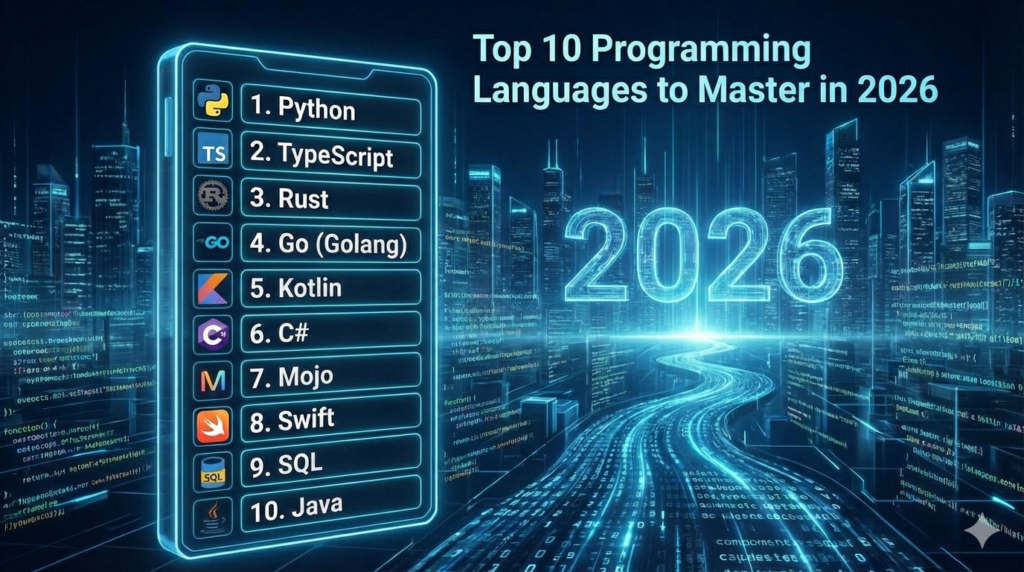
Here are the top 10 programming languages 2026 has to offer, based on market trends and community growth.
1. Python: The Undisputed King of AI
Let’s be honest; Python’s reign is far from over. In 2026, it remains the heartbeat of the entire AI and data science ecosystem. In the landscape of programming languages 2026 , Python remains the undisputed king of AI. From machine learning to automation and fintech, Python’s extensive libraries (like TensorFlow, PyTorch, and Pandas) make it the go-to language for solving complex problems .
Why you need it:
- AI & Machine Learning: It’s the primary language for training and utilizing Large Language Models (LLMs).
- Versatility: From web development (Django, Flask) to scripting, Python does it all.
- Community: The largest and most supportive community means you’re never stuck on a problem .
# Function to calculate factorial
def factorial(n):
    if n == 0:
        return 1
    else:
        return n * factorial(n-1)

numbers = [1, 2, 3, 4, 5]
for num in numbers:
    print(f"{num}! = {factorial(num)}")
# Output: 1! = 1, 2! = 2, 3! = 6, 4! = 24, 5! = 1202. TypeScript: JavaScript’s Powerful Armor
If you’re working on the web, vanilla JavaScript is no longer enough for large-scale projects. TypeScript has become the standard for enterprise-level web applications. By adding static typing, it acts as a safety net, catching errors before they reach production and making codebases infinitely more maintainable .
Why you need it:
- Error Reduction: Catch bugs during development, not at runtime.
- Enterprise Standard: Most modern frameworks (like Next.js) are built with TypeScript in mind.
- Scalability: Essential for large, complex front-end projects .
// Type safety prevents common errors
let message: string = "Hello, Technoption!";
let count: number = 42;

// Function with typed parameters and return value
function greet(name: string): string {
    return `Hello, ${name}!`;
}

console.log(greet("Developer")); // Output: Hello, Developer!3. Rust: Performance Meets Safety
Rust has been voted the “most loved” programming language for years, and in 2026, its practical application has finally caught up with its hype. For systems programming where both performance and memory safety are critical, Rust is now the default choice over C++ .
Why you need it:
- Memory Safety: Guarantees memory safety without needing a garbage collector.
- WebAssembly (WASM): Perfect for running high-performance code in the browser.
- Growing Demand: Especially in finance, critical infrastructure, and IoT devices .
fn main() {
    let s1 = String::from("hello");
    let s2 = s1; // ownership moves to s2

    // println!("{}", s1); // This would cause a compile error!
    println!("{}", s2); // Output: hello
}4. Go (Golang): The Cloud Native Powerhouse
Developed by Google, Go (Golang) continues to be the language of choice for building scalable and concurrent backend systems. If you are working with microservices, cloud platforms, or DevOps tools, Go is everywhere. Docker and Kubernetes are written in it .
Why you need it:
- Simplicity & Speed: Easy to learn but incredibly fast to execute.
- Concurrency: Built-in features make handling multiple tasks simultaneously a breeze.
- Cloud Dominance: The standard for modern cloud infrastructure .
package main

import (
    "fmt"
    "net/http"
)

func handler(w http.ResponseWriter, r *http.Request) {
    fmt.Fprintf(w, "Welcome to Technoption!")
}

func main() {
    http.HandleFunc("/", handler)
    http.ListenAndServe(":8080", nil)
}
// Visit http://localhost:8080 in your browser to see the message.5. Kotlin: The Modern Mobile Choice
While Java still holds a massive legacy footprint, Kotlin is now the undisputed language for modern Android development. Its concise syntax and interoperability with Java make it a joy to use. Furthermore, Kotlin Multiplatform is gaining traction, allowing you to share code between Android, iOS, and even backend services .
Why you need it:
- Official Android Language: It’s what Google recommends.
- Concise Code: Do more with less code compared to Java.
- Multiplatform Potential: Write once, share logic across multiple platforms .
fun main() {
    var message: String? = "Hello" // "?" allows null
    println(message?.length) // Safe call: prints 5

    message = null
    println(message?.length) // No error, prints null

    // println(message!!.length) // "!!" forces null check, would throw exception!
}6. C#: The Enterprise Stalwart
Don’t let the “legacy” label fool you. With the massive advancements in .NET (like .NET 9), C# has modernized into a high-performance, cross-platform powerhouse. It remains the top choice for large enterprises, game development (Unity), and Windows applications .
Why you need it:
- Enterprise Stability: Banks, insurance companies, and large corporations rely on it.
- Game Development: It’s the primary language for the Unity engine.
- Performance: .NET is now one of the fastest frameworks out there .
using System;
using System.Linq;
using System.Collections.Generic;

public class Program
{
    public static void Main()
    {
        int[] numbers = { 5, 10, 8, 3, 12, 7 };

        // LINQ query to find numbers greater than 5
        IEnumerable<int> largeNumbers = from num in numbers
                                         where num > 5
                                         orderby num
                                         select num;

        Console.WriteLine("Numbers greater than 5: " + string.Join(", ", largeNumbers));
        // Output: Numbers greater than 5: 7, 8, 10, 12
    }
}7. Mojo: The Rising Star
If Python’s syntax could marry C++’s speed, the child would be Mojo. Designed to be a superset of Python, Mojo solves Python’s performance limitations, making it ideal for writing high-performance AI hardware (GPUs, TPUs) code without leaving the familiar Python ecosystem .
Why you need it:
- The Best of Both Worlds: Python usability with C-level speed.
- Future of AI: Specifically designed for the next generation of AI hardware.
struct Point:
    var x: Float32
    var y: Float32

    fn __init__(inout self, x: Float32, y: Float32):
        self.x = x
        self.y = y

    fn distance(self, other: Point) -> Float32:
        return ((self.x - other.x)**2 + (self.y - other.y)**2).sqrt()

let p1 = Point(0, 0)
let p2 = Point(3, 4)
print(p1.distance(p2)) # Output: 5.08. Swift: Apple’s Ecosystem Gatekeeper
As long as Apple devices exist, Swift will be in demand. For anyone looking to build apps for iOS, macOS, watchOS, or the new visionOS, Swift is the only path forward. It’s modern, safe, and fast .
Why you need it:
- Apple Ecosystem: The key to the lucrative App Store market.
- Safety & Performance: Designed to be a safer, more modern alternative to Objective-C.
struct Car {
    var brand: String
    var model: String
    var year: Int

    func description() -> String {
        return "\(year) \(brand) \(model)"
    }
}

let myCar = Car(brand: "Tesla", model: "Model Y", year: 2023)
print(myCar.description()) // Output: 2023 Tesla Model Y9. SQL: The Evergreen Data Language
It’s not new, it’s not flashy, but everyone still needs it. In the world of Big Data, the ability to query databases effectively is a superpower. Whether you’re a backend dev, a data scientist, or a business analyst, SQL remains a non-negotiable skill in 2026 .
Why you need it:
- Universality: Every application needs a database.
- Data Literacy: The foundational skill for understanding and manipulating data.
-- Select customers from a specific city
SELECT first_name, last_name, email
FROM customers
WHERE city = 'Istanbul'
ORDER BY first_name ASC;10. Java: The Undying Workhorse
Despite newer languages gaining popularity, Java (especially with long-term support versions like Java 21) remains the backbone of the world’s largest enterprise systems. Its stability, maturity, and the massive existing codebase ensure that Java developers will be needed for decades to come .
Why you need it:
- Legacy & Stability: Powers the backend of countless banks, retailers, and governments.
- Job Security: A vast number of existing jobs require Java maintenance and development.
public class Main {
    public static void main(String[] args) {
        String language = "Java";
        System.out.println("Hello from " + language + "!");
    }
}
// Output: Hello from Java!How to Choose the Best **Programming Languages 2026** for Your Career
The best language for you depends on your career goals.
- Aspiring Data Scientist? Start with Python .
- Future Full-Stack Web Developer? Master TypeScript and a framework like React or Next.js .
- Cloud & Systems Engineer? Dive into Go or Rust .
- Mobile App Creator? Choose Kotlin (Android) or Swift (iOS) .
Choosing the right programming languages 2026 depends on your career goals, but this list provides a solid roadmap.
Which language are you planning to master this year? Let us know in the comments below!